75 Defence Space Mission Challenges were released during the Def Expo at Gandhinagar in October 2022. There has been slow progress in completion of Feasibility Studies and consequent procurement process due to the route which is to be taken Make, iDEX etc due to the capital required to execute these projects. Historically deep-tech domains in general and space-tech in particular have not been very attractive from an investment perspective in India. Space-tech is a CapEx heavy domain that also requires significant investment of resources and manpower for research and development activities. R&D activities may not always lead to immediately monetizable outcomes. During various conclaves I have proposed that there is a requirement to treat Space for Military Purpose may be differently and as a separate chapter as part of Defence Acquisition Procedure with a distinct funding mechanism as Space is central to NATIONAL POWER. In number of countries Military takes the lead for development of capabilities in Space. Funding is an issue for Space Tech Start Ups. Let us analyse the issue and suggest certain recommendations.
Bharat Space Tech Innovation Fund

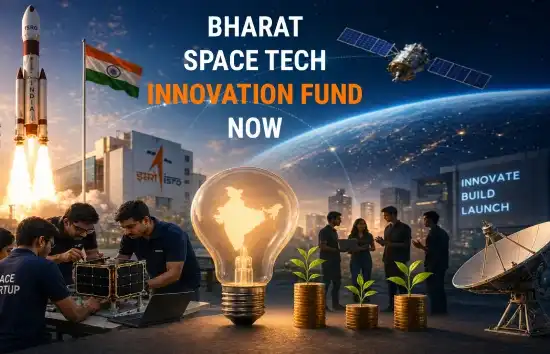
Current Grant Schemes vis-a vis Space Tech
While IDEX and Make schemes have been a good first step to encourage innovation in defence and space, there are a few issues with the schemes especially with respect to space sector:
● The quantum of funding from IDEX (Rs 1.5 crores) does not suffice for complete space systems
● IDEX, IDEX prime and Aditi also require matching contributions of Rs 1.5 crore, Rs 10 crore and Rs 25 crore respectively from the winners. The matching contribution aspect, especially for IDEX Prime and Aditi, become blockers for smaller companies to meaningfully compete for them. Effectively IDEX Prime and Aditi are feasible only for companies with excess capital on their books. Financial capacity does not equal tech merit.
● If a startup is required to raise funds only to fulfil the matching contribution criteria, this indirectly results in dilution of the holding structure of companies. For early stage startups this might mean significant dilution wherein the founders may lose control of the company at a seed investment level. This scenario won’t just affect the strategic direction of such companies but also make it extremely hard to raise further rounds.
● Bigger quantum of investment makes it more likely for startups to seek funding from foreign sources.
● Currently, Make 2 scheme requires companies to invest in projects without a grant and without a commitment for purchase orders on successful demonstration. It is essentially an NCNC process for innovation. Financially only profitable big companies can meaningfully apply for Make 2 since the projects under Make 2 can often entail investment in the order of Rs 250 crores. But for such companies the risk associated with making such a huge investment without any guarantee of revenue goes against the fiduciary responsibility of promoters of such companies to their shareholders.
● As per the current structures and constraints of IDEX and Make, they are ideally feasible for companies as follows:
○ IDEX: Early stage startups
○ IDEX Prime: funded startups with at least Rs 20 crores funding; cash flow positive MSMEs/startups
○ ADITI: funded startups with at least Rs 50 crores funding; cash flow positive MSMEs/startups
○ Make 1: Big companies, Consortium of big companies, MSMEs and startups
○ Make 2: Government research organisations, PSUs with significant R&D budget, large companies with R&D focus
● Because it is extremely easy to get a DPIIT startup certificate, schemes meant for startups can be used by bigger companies as well as foreign companies by forming direct or indirect subsidiaries.
● Today, a key criteria for awarding IDEX, IDEX Prime, Aditi, Make projects is financial capability rather than tech capability. This is also reflected in the feasibility study document of DIO which primarily asks about the financial status of a company.
● Feasibility study is done as an afterthought and doesn’t focus on technical feasibility. The focus should be more on the science and technology behind the sought innovation. Ideal feasibility study should contain the following:
○ PSQR
○ Scientific/Technological background
○ Comparative global technology
○ Relevant research papers in case the sought innovation hasn’t been implemented or productised anywhere in the world
○ Justification of budget and timeline
○ Relevant competency of team
○ Access to infrastructure and capital
● Feasibility study should ideally be a dedicated effort led by innovators to clearly define the PSQR and convince the nodal authorities of the same. In the proposed scheme, feasibility study is to be a milestone deliverable for Phase I.
● TDF with its outlay of Rs 50 crores and 90:10 split of grant and matching contribution is the ideal scheme for defence and space technology. But it is limited to projects under the purview of DRDO.
Philosophy Behind Proposed Scheme
Deep-tech companies working in the space sector with a focus on R&D find it difficult to raise initial investment from Indian investors because of hesitance of Indian investors to invest in Capital Expenditure heavy operations without predictable and scalable revenue models. Innovative R&D activities may not have clarity in terms of revenue generation at initial stages. Proving the feasibility of an idea through actual development of a demonstration model is the first step towards commercialisation and this would require an initial investment.
Big companies and startups with steady revenue streams have the wherewithal to invest in R&D. Schemes such as IDEX and Aditi that require 100% matching contribution are difficult for startups with less funding to execute and fulfil. Those schemes are still applicable to all companies without prejudice.
The ability to innovate is not related to the financial status of a company. Fundability of a company is not an indicator of the technical competence of a startup. The proposed grant scheme is meant to encourage tech development efforts of pre-revenue stage startups that have the intellectual capability to innovate in space-tech but may not have the financial wherewithal to execute their ideas.
Proposal for a New Grant Scheme Dedicated to Space Tech Startups
Aim: To stimulate technological innovation in the Indian space sector by providing funding and support to startups and small businesses engaged in space-related research and development (R&D). Promote indigenous design and development of space technology in India.
Structure:
1. Phase I: Feasibility Study, System Design and Lab Demo
○ Target TRL: 3
○ Goal: To establish the technical merit and feasibility of the proposed innovation.
○ Deliverables:
■ Detailed feasibility study document
■ System design document
■ BOM analysis
■ Lab demonstration model
○ Funding:
■ Rs 1 crore
■ No matching contribution required
■ Tranche 1: 10% on submission and successful review of feasibility study document
■ Tranche 2: 45% on submission and successful review of system design document and BOM analysis
● Tranche 1 and Tranche 2 payment should suffice for sourcing materials for lab demo
■ Tranche 3: 45% on submission and successful review of lab demo
○ Timeline: 6-12 months
○ Process:
■ HPSC
■ Vetting of financials of startup
■ Contract signing
■ Review of milestone 1
● Release of Tranche 1
■ Review of milestone 2
● Release of Tranche 2
■ Review of milestone 3
● Release of Tranche 3
○ Eligibility: Indian startups that meet the eligibility criteria mentioned in Checks and Balances section below
2. Phase II: Prototype Development
○ Target TRL: 6
○ Goal: To expand on the R&D efforts initiated in Phase I and develop a working prototype.
○ Deliverable: A fully functional prototype (engineering model) ready for further testing and validation in a suitable environment.
○ Funding:
■ Up to Rs 10 crores
■ No matching contribution required
■ Tranche 1: 50% after successful review of BOM and overall budget analysis
■ Tranche 2: 40% after development and demonstration of prototype
■ Tranche 3: 10% after successful testing of prototype in IN-SPACe facilities
○ Timeline: 12-24 months
○ Process:
■ Milestone 1: Budget finalisation review and finalisation of scope of demonstration with nodal authority
● Contract signing and release of Tranche 1
■ Milestone 2:
● Demonstration of prototype as per committed scope in Milestone 1
● Check for indigenisation. At least 75% of the components (by value) should be indigenously sourced. An exception list of components can be made for those components that are not indigenously manufactured in India.
● Review of company’s finances to ensure that the company hasn’t white-labelled the solution from foreign vendors
● Release of Tranche 2
■ Milestone 3: successful testing of prototype in IN-SPACe facilities
● Release of Tranche 3
○ Eligibility: Eligible startups that have successfully cleared Phase I
3. Phase III: Commercialisation
○ Target TRL: 8/9
○ Goal: To support the commercialisation of the developed technology.
○ Deliverable: Market-ready product or service, with potential customers or partners identified.
○ Funding:
■ No direct funding
■ Procurement contract with the government with MOQ of at least 1
● Procurement pricing should consider NRE cost, BOM and reasonable profit margin.
● Procurement pricing should not be greater than 80% of price of similar tech if acquired from foreign vendors
■ Access to venture capital, angel investors, and other funding sources
■ Facilitation of partnerships with industry maybe provided
■ Facilitate export licence for non-critical technology
■ Facilitate fast-track qualification of developed systems
○ Eligibility: Eligible startups that have successfully cleared Phase II
Checks and Balances:
The following conditions are meant to mitigate chances of abuse of the scheme.
● Eligibility: Indian Startups only
○ Non-eligibility: This scheme is not applicable for
■ Subsidiaries of foreign companies
■ Subsidiaries of profitable companies
■ PSUs
■ Publicly traded companies
● OpEx such as salaries should not be counted in BOM
● For phase II, up to 40% budget can go towards salaries and OpEx
● All payments will be milestone based
● All payments will be post facto after successful defence of corresponding milestone
● Milestone review should be done through review committees
○ Review committee should consist of:
■ Domain experts (from academia, ISRO, DRDO)
■ Military officers from the relevant services that are target customers for the tech
■ Bureaucrats from relevant ministries that maybe target customers for the tech (optional)
■ CA (for milestone reviews that deal with financial review)
○ Review committee members should not have conflict of interest
● Indemnity bond for phase II
○ If during Milestone 2 review of Phase II, if discrepancies are found in terms of indigenisation conditions or if the company is found to have white-labelled their solution from a foreign vendor, then company will be liable to pay back all the remitted grants associated with Phase II
Similar Global Programmes being followed across the world are as follows :-
|
Country |
Funding Mechanism |
Sector |
Typical Funding Amount |
Funding Timeline |
Eligibility |
|
US |
NASA Grants and Contracts |
Space |
Varies widely; up to millions depending on project scope |
Usually annual or multi-year |
Businesses, universities, research institutions |
|
DoD and DARPA Projects |
Defense |
$100K–$10M+ depending on project and scope |
Multi-year |
Businesses, universities with defence-focused tech |
|
|
SBIR/STTR Programs |
Space & Defense |
Phase I: Up to $150K; Phase II: Up to $1M |
Phase I: 6 months; Phase II: 2 years |
Small businesses engaging in federal R&D with commercial potential |
|
|
UK |
UK Space Agency Grants |
Space |
£50K–£2M depending on project type |
1–3 years |
UK-based companies, research organisations |
|
Defence and Security Accelerator (DASA) |
Defense |
£100K–£1M+ |
6 months to 3 years |
UK entities, often focuses on innovative defence solutions |
|
|
Japan |
JAXA Sponsored Research |
Space |
¥10M–¥100M+ |
1–5 years |
Japanese entities, universities, businesses |
|
Acquisition, Technology & Logistics Agency (ATLA) |
Defense |
¥10M–¥100M+ |
1–5 years |
Japanese companies, focuses on defence technology |
|
|
France |
CNES Funding |
Space |
€100K–€5M |
1–5 years |
French companies, research institutions |
|
Directorate General of Armaments (DGA) |
Defense |
€100K–€10M+ |
1–5 years |
French entities, defence industry focus |
|
|
Canada |
Canadian Space Agency Programs |
Space |
CAD 100K–CAD 5M |
1–5 years |
Canadian businesses, academia |
|
Defence Research and Development Canada (DRDC) |
Defense |
CAD 50K–CAD 2M+ |
1–5 years |
Canadian entities, defence sector |